Welcome To Lilanga's

General Technology, Programming Languages, Computer Technology, IT

Last week, Google announced that their new hyper indexing system was live across all data centers.
Google just got fresher and faster with the release of their new indexing system, Caffeine. In short, old Google indexing = built with layers that would get refreshed at varying frequencies and result in content often not updated for days or weeks. New Google indexing (Caffeine) = analyzes smaller chunks of the web and updates continuously; so content is much fresher! So our Google now able to provide more and more updated results from the past 24 hours.


According to Carrie Grimes, Software Engineer at Google
"Caffeine provides 50 percent fresher results for web searches than our last index, and it's the largest collection of web content we've offered. Whether it's a news story, a blog or a forum post, you can now find links to relevant content much sooner after it is published than was possible ever before.

Some background for those of you who don't build search engines for a living like us: when you search Google, you're not searching the live web. Instead you're searching Google's index of the web which, like the list in the back of a book, helps you pinpoint exactly the information you need. (Here's a good explanation of how it all works.)

So why did we build a new search indexing system? Content on the web is blossoming. It's growing not just in size and numbers but with the advent of video, images, news and real-time updates, the average webpage is richer and more complex. In addition, people's expectations for search are higher than they used to be. Searchers want to find the latest relevant content and publishers expect to be found the instant they publish.

To keep up with the evolution of the web and to meet rising user expectations, we've built Caffeine. The image below illustrates how our old indexing system worked compared to Caffeine:


Our old index had several layers, some of which were refreshed at a faster rate than others; the main layer would update every couple of weeks. To refresh a layer of the old index, we would analyze the entire web, which meant there was a significant delay between when we found a page and made it available to you.

With Caffeine, we analyze the web in small portions and update our search index on a continuous basis, globally. As we find new pages, or new information on existing pages, we can add these straight to the index. That means you can find fresher information than ever before—no matter when or where it was published.

Caffeine lets us index web pages on an enormous scale. In fact, every second Caffeine processes hundreds of thousands of pages in parallel. If this were a pile of paper it would grow three miles taller every second. Caffeine takes up nearly 100 million gigabytes of storage in one database and adds new information at a rate of hundreds of thousands of gigabytes per day. You would need 625,000 of the largest iPods to store that much information; if these were stacked end-to-end they would go for more than 40 miles.

We've built Caffeine with the future in mind. Not only is it fresher, it's a robust foundation that makes it possible for us to build an even faster and comprehensive search engine that scales with the growth of information online, and delivers even more relevant search results to you. So stay tuned, and look for more improvements in the months to come."

HP has just announced that it's acquiring Palm to the tune of $1.2 billion, which works out to $5.70 per share of Palm common stock. The deal is planned to close by July 31, which marks the end of HP's third fiscal quarter of the year. Current Palm CEO Jon Rubinstein is "expected to remain with the company," though it's not said in what capacity. Press release after the break. There will be a call to discuss the acquisition in more detail

Update: PreCentral's managed to grab a copy of Rubinstein's letter to Palm employees.

Press Release
"PALO ALTO, Calif. & SUNNYVALE, Calif.--(BUSINESS WIRE)--HP (NYSE: HPQ - News) and Palm, Inc. (NASDAQ: PALM - News) today announced that they have entered into a definitive agreement under which HP will purchase Palm, a provider of smartphones powered by the Palm webOS mobile operating system, at a price of $5.70 per share of Palm common stock in cash or an enterprise value of approximately $1.2 billion. The transaction has been approved by the HP and Palm boards of directors.

The combination of HP's global scale and financial strength with Palm's unparalleled webOS platform will enhance HP's ability to participate more aggressively in the fast-growing, highly profitable smartphone and connected mobile device markets. Palm's unique webOS will allow HP to take advantage of features such as true multitasking and always up-to-date information sharing across applications.

"Palm's innovative operating system provides an ideal platform to expand HP's mobility strategy and create a unique HP experience spanning multiple mobile connected devices," said Todd Bradley, executive vice president, Personal Systems Group, HP. "And, Palm possesses significant IP assets and has a highly skilled team. The smartphone market is large, profitable and rapidly growing, and companies that can provide an integrated device and experience command a higher share. Advances in mobility are offering significant opportunities, and HP intends to be a leader in this market."

"We're thrilled by HP's vote of confidence in Palm's technological leadership, which delivered Palm webOS and iconic products such as the Palm Pre. HP's longstanding culture of innovation, scale and global operating resources make it the perfect partner to rapidly accelerate the growth of webOS," said Jon Rubinstein, chairman and chief executive officer, Palm. "We look forward to working with HP to continue to deliver industry-leading mobile experiences to our customers and business partners."

Under the terms of the merger agreement, Palm stockholders will receive $5.70 in cash for each share of Palm common stock that they hold at the closing of the merger. The merger consideration takes into account the updated guidance and other financial information being released by Palm this afternoon. The acquisition is subject to customary closing conditions, including the receipt of domestic and foreign regulatory approvals and the approval of Palm's stockholders. The transaction is expected to close during HP's third fiscal quarter ending July 31, 2010."

Palm's current chairman and CEO, Jon Rubinstein, is expected to remain with the company.

Phone 4. In so many ways, it's a first.

While everyone else was busy trying to keep up with iPhone, we were busy creating amazing new features that make iPhone more powerful, easier to use, and more indispensable than ever. The result is iPhone 4. The biggest thing to happen to iPhone since iPhone.

FaceTime

People have been dreaming about video calling for decades. iPhone 4 makes it a reality. With just a tap, you can wave hello to your kids, share a smile from across the globe, or watch your best friend laugh at your stories — iPhone 4 to iPhone 4 over Wi-Fi. And it works right out of the box. No other phone makes staying in touch this much fun.

Retina Display

The Retina display on iPhone 4 is the sharpest, most vibrant, highest-resolution phone screen ever, with four times the pixel count of previous iPhone models. In fact, the pixel density is so high that the human eye is unable to distinguish individual pixels. Which makes text amazingly crisp and images stunningly sharp.

Multitasking

iPhone 4 introduces a whole new way of multitasking. Now you can run your favorite third-party apps — and switch between them instantly — without slowing down the performance of the foreground app or draining the battery unnecessarily.1 This smarter approach to multitasking is available only on iPhone.

HD Video Recording and Editing

Shoot your own movies in high definition. Capture impressive video even in low-light settings, thanks to the advanced backside illumination sensor and built-in LED light. Then edit and create your own mini-masterpiece right on iPhone 4 using the new iMovie app — with Apple-designed themes, titles, and transitions. It’s coming soon to the App Store for $4.99.

5-Megapixel Camera with LED Flash

Take beautiful, detailed photos with the new 5-megapixel camera with built-in LED flash. The advanced backside illumination sensor captures great pictures even in low light. And the new front-facing camera makes it easy to take self-portraits.

And much, much more.

Pre-order iPhone 4 starting June 15.

Palm isn't hot on Pre overclocking, indicates warranties at risk[Repost of BloombergApril 12] Palm Inc., creator of the Pre smartphone, is seeking bids for the company as early as this week, according to three people familiar with the situation.

The company is working with Goldman Sachs Group Inc. and Frank Quattrone’s Qatalyst Partners to find a buyer, said the people, who declined to be identified because a sale hasn’t been announced. Taiwan’s HTC Corp. and China’s Lenovo Group Ltd. have looked at the company and may make offers, said the people.

Palm, which helped pioneer the market for personal digital assistants, would offer suitors the WebOS software that competes against mobile operating systems from iPhone maker Apple Inc. and Google Inc. For Elevation Partners LP, the firm that owns about 30 percent of Palm, a sale may end the volatility of an investment in a stock that surged more than 10-fold since December 2008 before erasing most of the gain.

“Palm still has quite a good brand in the U.S. market, and some strong technology, so you can do something with it,” said Frank He, a technology analyst at BOC International Holdings Ltd. in Hong Kong. “The shares have gone down a lot and the company may become attractive to anyone looking for a turnaround play.”

The Sunnyvale, California-based device maker surged 32 percent last week on the Nasdaq Stock Market on renewed speculation of a takeover bid. Before the rally, the stock had plunged more than 60 percent this year, dragged down by disappointing sales of the Pre and Pixi phones.

Missing Estimates

Palm rose 71 cents, or 14 percent, to $5.87 at 9:38 a.m. New York time in Nasdaq Stock Market trading. Earlier the stock jumped as much as 16 percent.

Chief Financial Officer Doug Jeffries last month forecast sales in the quarter ending in May will be less than $150 million, compared with the $300 million average of analysts’ estimates compiled by Bloomberg at the time.

Palm, which had a market value of $870.8 million before today, ranked sixth in the North American smartphone market during the three months ended Dec. 31 with a 4.3 percent share, according to Gartner Inc. Research in Motion Ltd., maker of the BlackBerry, led with 44 percent, followed by Apple’s 24 percent, according to the Stamford, Connecticut-based research company.

Chief Executive Officer Jon Rubinstein, who developed Palm’s latest operating system, was counting on the Pre and Pixi smartphones to attract customers. The company has patents from mobile hardware to software and power-saving technologies.

Lenovo, Dell

Lynn Fox, a Palm spokeswoman, declined to comment. Qatalyst’s Sally Palmer and Goldman’s Andrea Rachman didn’t immediately respond to requests for comment. Chen Hui-Ming, the chief financial officer of HTC, declined to confirm or deny the company’s interest in Palm.

Wong Wai Ming, Lenovo’s chief financial officer, also declined to comment on the company’s acquisition plans. In January, Lenovo paid $200 million to purchase Lenovo Mobile Communication Technology Ltd., letting it re-enter the market for handsets. The company had sold the mobile-phone unit in 2008 to focus on personal computers.

Palm shares have been buoyed in the past on speculation the company would be bought by Nokia Oyj. The Finnish company today declined to say if it might be interested.

“We never speculate or comment on market rumors,” said Arja Suominen, a Nokia spokeswoman.

Dell Inc. looked at Palm, though it decided against an offer, according to two of the people familiar with the matter. Jess Blackburn, a spokesman for the Round Rock, Texas-based computer maker, didn’t respond to a call for comment.

Burning Cash

Unlisted Huawei Technologies Co. and ZTE Corp., China’s two biggest makers of phone equipment, may be more likely bidders for Palm than HTC or Lenovo, said Lu Chia-lin, a technology analyst at Macquarie Group Ltd. in Taipei.

Chinese companies “have been quite eager to expand their international markets,” said Lu.

Palm may burn $80 million every three months for the next five quarters as competition in the smartphone market intensifies, Berenberg Bank analysts including Adnaan Ahmad wrote in a March 25 report. The company held $592 million in cash and short-term investments at the end of its fiscal third- quarter, according to the report.

Ross Gan, a spokesman at Huawei, said the company is always open to opportunities, though he declined to comment on speculation about mergers and acquisitions as a matter of policy. Margrete Ma, a ZTE spokeswoman, couldn’t immediately be reached for comment.

Market Pioneer

After Palm introduced the Pre at the Consumer Electronics Show in January 2009, the stock jumped 80 percent in two days to $5.96. By September, the shares had climbed as high as $17.46.

The stock then dropped 79 percent over the next six months as Palm’s sales growth was outpaced by marketing costs, and the company lost market share to Apple and phones equipped with Google’s Android. Palm has posted 11 straight quarterly losses.

Founded in 1992, Palm helped pioneer the market for handheld organizers with its PalmPilot devices. The company was acquired by U.S. Robotics, which was in turn purchased by 3Com Corp. 3Com spun off Palm in 2000.

Rubinstein joined the company after leading development of Apple’s best-selling iPod media player. He was recruited to Palm by Fred Anderson, Apple’s former finance chief and a co-founder of Elevation Partners.

The Pre was Palm’s first phone based on WebOS. It went on sale in June 2009, followed by the smaller, cheaper Pixi in November. The phones let users send e-mail, surf the Web, stream video and run multiple applications at the same time.

Both devices were sold in the U.S. exclusively by Sprint Nextel Corp., the country’s third-largest carrier, until Verizon Wireless began offering enhanced versions in January.

This is repost of Bloomberg article submitted by Serena Saitto and Ari Levy.

ScreenshotATI's Radeon 5870 and the rest of its DirectX 11 GPU family has been available in market for 6 months now while Nvidia irons up its highly anticipated Fermi GPU lineup.

Turkish site, Donanimharber, managed to get their hands on the first official photos of Nvidia's upcoming high end DirectX 11 Fermi-based graphics card, the GeForce GTX 480 and GeForce GTX 470.

Specs and pricing of both cards have been revealed by VR-Zone. According to the publication, the cards are scheduled for March 26th release. The GTX 480 features a core clock of 700MHz, shader clock of 1401MHz, and a memory clock of 1848MHz. The memory interface will be 384-bit and the card will have 1536MB of RAM and a 250W TDP. The card will sell for $499, which is typical for a new high-end card.

The GTX 470 sports a core clock of 607MHz, shader clock of 1215MHz, and a memory clock of 1674MHz. The card will have a 320-bit memory interface and 1280MB of RAM. The TDP is said to be 225W and the card will sell for $349.

Initial benchmarks has shown that GTX 480 and GTX 470 are at least 5 to 10 percent faster than their ATI HD 5850 and ATI HD 5870 counterparts.

A slide from Panasonic showing how active shutter technology worksXpanD is offering a solution to the frustration of having to potentially purchase numerous sets of brand-specific glasses in order to enjoy 3D content on different televisions and 3D-enabled devices. Its X103 active shutter glasses are said to work on almost all new 3D-ready TVs, no matter the brand.

This year is being hailed as the year of 3D. And with it comes yet another chance for manufacturers to make proprietary peripherals essential for three-dimensional viewing enjoying. Many of the recent 3D television announcements were accompanied by news that the pair of glasses buyers will need to watch content will be brand specific, so your Samsung glasses won't work when you visit friends to watch the game on their Panasonic set.

In the XpanD X103 there is promise of a solution. The company claims to "deliver unparalleled freedom by offering the universal 3D viewing technology in any environment, on any device!" Unlike passive polarized solutions which use filters to feed eye specific images to the brain, the active shutter glasses utilize a fast-switching, liquid crystal technology known as "Pi-Cell" which rapidly blocks alternate eyes in refresh sync with the separate left and right eye images being shown on the screen, thus creating the illusion of stereoscopic vision and depth perception.

XpanD claims that its technology offers "the fastest shutter speed in the market today" which should give users "optimal Stereoscopic 3D images without any ghosting, minimal light loss and no visual distortion". The batteries are said to last around 250 hours and are user replaceable and the X103 glasses use various methods to communicate with "a very wide range of stereoscopic applications from the Cinema to the PC".

XpanD's Ami Dror said of the development: "The main problem with display-linked active glasses lies within the incapability to use these glasses with a 3D TV that is manufactured by another brand. While we support TV manufacturers by manufacturing glasses for them, we are also requested by the same manufacturers to sell universal active glasses that will work with all the modern 3D TVs. TV retailers cannot maintain 15 different models of glasses to support 15 different TV brands, rental AV companies cannot do it, and even 3D broadcasters ask for a universal pair of glasses that they can provide their 3D channel subscribers."

The company claims that users will even be able to take their XpanD X103's to the cinema with them when going to see a 3D movie.

tak, turbine light, wind power, wind energyWind, as we all know, can be used to generate electricity. Turbines installed in wind-prone areas have been proven generators of clean, green power. But most of the time, you need open areas and large spaces to locate these. So how do you bring wind power to the city? Mark Oberholzer may have just the solution, designing a system that would generate power from a rather unique place: The New Jersey highway. And he doesn’t propose that we install wind turbines near the highway, but rather, that they be put in the highway, and that they power a light-rail transport system.

The design, a runner-up in the 2006 Metropolis Mag Next Generation Design Competition proposed the integration of wind-turbines into the highway barriers that divide the traffic. These turbines would generate power from the wind created by the vehicles that drive past them in opposite directions. Originally conceived as a single row of vertical-axis rotary turbines, it has now been redesigned to include two rows, one stacked on top of each other, with the end power being used to power a light rail system.

“The peaks of traffic flow more or less coincide with those of energy use,” Mark says. As the traffic peak hour matches requires the moving of a large amount of people, integrating it with a traffic rail system may have a second beneficial effect: that of decongesting the busy highways.

Logo

As more and more people across the world adopt cars as their primary mode of transportation, well-lit highways become increasingly important. But how can we sustainably power all those energy-sucking lights? TAK Studio addressed that question in their entry into this year’s Greener Gadgets competition to find the green technology solution of the future. Dubbed the Turbine Light, their design aims to illuminate roadways using the power of the wind.

TAK’s wind-powered light uses the moving air from cars zipping by on the highway to generate energy that can be used to power roadside lighting. It’s a controversial idea–could wind from passing cars actually provide enough power for lighting?–but one that has the potential to save lots of cash in already wind-heavy regions. Alternatively, cities might consider using solar-powered lights instead. The idea has been proven to work many times over, including at the recent COP15 climate change conference.

samsung-oled-laptop1 Samsung are showing a laptop that uses a 14" transparent OLED display.The OLED is up to 40% transparent. Samsung actually plans to release this laptop as a real product within 12 months.

Samsung wants to dominate the transparent display market, and plans to introduce a range of new products with such displays within the next year. They will even consider products not normally produced at Samsung such as a transparent automobile navigation system that can be placed on a windscreen.

Transparent AMOLED displays provide the user with a screen behind which objects are still visible. Samsung has been showing prototypes of these displays at shows such as SID, but recently unveiled footage of an actual product that would exploit clear AMOLED displays.

The first device being introduced by the company using the technology is the IceTouch (YP-H1) MP3 player. The product functions as a hybrid music player, radio, DVD player, picture viewer and portable storage unit.

'The AMOLED display not only visually set our product apart from our competitors but we believe it well will set the bar for the next generation of portable MP3 players,' says Reid Sullivan, VP of audio/video and digital imaging marketing at Samsung Electronics America.

They also reveal that the IceTouch MP3 player will sell for around $330 and will be released in the US in the first half of 2010.

Samsung also plans to release a laptop featuring a 14-inch see-through color OLED screen. Trials suggest that the company will have the product ready for launch within 12 months.

'We have a lab in Korea that is currently working on developing a laptop with partially-transparent screen,' explains Sullivan. 'Soon, I imagine that all Samsung's audio-visual products will feature this technology. We want to be the first in this market.'

Competitors in the consumer electronics market include Sony Ericsson, which recently released its Xperia Pureness Smartphone, featuring a clear display, in Europe. However, Samsung is keen to dominate this market from early on.

'We are looking at devices that could use transparent AMOLED technology, even if it is a product we are not usually associated with,' states Reid. 'Systems such as transparent Sat-Nav's that can be placed on a windscreen but also operate as a navigational unit when required, are all possibilities.'

Samsung set the bar high when it came to commercializing AMOLED displays in large volumes a few years ago. Over 70% of AMOLED displays in mobile phones come from a Samsung lab. Yet competition is intensifying as the company and its rivals such as LG explore new applications for AMOLED technology. Smartphones and devices that use 3-inch displays and above are earmarked as the next market of consumer electronics fit for AMOLED technology, where premium products can benefit from more advanced but costly display technologies.

Transparent AMOLED displays could be used to enhance new products too.

The public battle between Adobe and Apple over bringing Flash to the iPhone, and now iPad, platforms has heated up the debate over the life expectancy of Flash as newer technologies, specifically the emerging HTML5 standard, enter the scene.
Adobe Flash helped to fill a void for a cross-platform multimedia experience on the Web. With the glaring exception of the iPhone and upcoming iPad, Flash can be found on virtually every other operating system--desktop and mobile, and for every Web browser.
Flash is almost a standard in and of itself. Just try surfing the Web without installing the Flash Player software and you will quickly see just how pervasive Flash is. As close as it is to being a standard, though, it is still a proprietary technology from one vendor.
The advantage that HTML5 has over Flash, and other proprietary Web development platforms like Microsoft's Silverlight, is that it is a protocol standard--or at least it will be once it's finalized, not a single-vendor solution.
Small and medium businesses (SMB's) pay huge sums of money, at least huge to them relative to their overall budgets, to developers to create and maintain Web sites. Many of those Web sites rely heavily on Adobe Flash to provide animations and other cool, interactive content.
Abandoning Flash would require a Web redesign, which can be a formidable, frightening, and costly undertaking. However, if Flash is dying a slow death SMB's might be doing themselves a favor by hitching their sites to a rising star like HTML5--even if only by attrition rather than a complete revamp of the site.
Flash isn't truly dead yet, though. In fact, it could be a long while before HTML5 gains enough traction to truly threaten Flash.
Adobe CEO Shantanu Naranyen said during the Adobe Q2 2009 earnings call "I think the challenge for HTLM 5 will continue to be how do you get a consistent display of HTML 5 across browsers. And when you think about when the rollout plans that are currently being talked about, they feel like it might be a decade before HTML 5 sees standardization across the number of browsers that are going to be out there."
HTML5 has been under development since 2004, and only now is it becoming mainstream enough to start showing up in Web browsers and Web sites. But, the current versions of the top three browsers--Internet Explorer, Firefox, and Chrome--all contain elements of HTML5 compatibility.
HTML5 doesn't have to mean the death of Flash, though. There is also an opportunity for Adobe to adapt and evolve Flash to continue playing an important role even in an HTML5 world. HTML5 may deliver much of the same features and functionality that developers rely on Flash for today, but HTML5 won't be perfect and it won't do everything, so Adobe can reinvent Flash to fill a new void.
Still, Flash is a single-vendor solution that requires users to install additional software in order to view it, and the battle with Apple illustrates why Flash may not be available for all platforms. Small and medium businesses should seriously look into migrating to HTML5 for future Web development projects to embrace the coming standard and stay ahead of the game.

This is a repost of Tony Bradley’s article on PC World

"People's lives are at stake," Russian scientist Anatoly Perminov told the Russian radio station Golos Rossii. "We should pay several hundred million dollars and build a system that would allow us to prevent a collision, rather than sit and wait for it to happen and kill hundreds of thousands of people." 

Perminov was talking about the Russian scientists plan to spend several hundreds of millions of dollars to design and implement a system capable of deflecting large meteors out of earth's path. 

"Calculations show that it's possible to create a special-purpose spacecraft within the time we have, which would help avoid the collision. The threat of collision can be averted," Perminov added. 

According to NASA, there is a slim chance that the Apophis asteroid might hit earth in 2036. 

Details of the plan still need to be work out, but Perminov has invited NASA, the ESA and other space agencies to participate. 

Unrelated to the Russian project, space researcher Matt Genge from the Imperial College London has calculated that a spaceship to move the asteroid to a different trajectory would only need to have the approximate mass, acceleration, and thrust of a small car to push the asteroid out of the path of Earth in 75 days. 

Matt also calculated that painting the meteor or covering it with mirrors would change the way it absorbs heat energy enough to steer it out of earth's path in 20 years.


8.9-inch ExoPC Slate has iPad looks, netbook internals, Windows 7 soul

Yes, we realize that it's hard to provide too much visual differentiation between tablet PCs with large, ebony bezels, but we can't help but think that this 8.9-inch multi-touch tablet looks a lot like another,recently announced 9.7-inch multitouch tablet. Nevertheless this one's quite different on the inside, delivering "the web without compromise," meaning full browser support with flash courtesy of Windows 7 on an Atom N270 at 1.6GHz, with 2GB of DDR2 memory and a 32GB SSD with SD expansion. Yeah, those specs are familiar too, and while we're not thinking this will deliver the sort of snappy performance seen on the iPad, it will certainly be a lot more functional. Battery life is only four hours, but at last it user-replaceable, and a price of $599 matches the 32GB iPad. Likewise it will be available in March -- or you can get a non-multitouch prototype for $780 right this very moment. If, that is, you speak enough French to manage the order page.

Original post by:  Tim Stevens

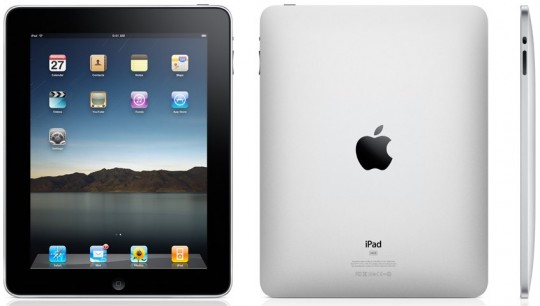
Apple iPad official 1 540x306Apple have unveiled the iPad, their long-awaited and much-rumored tablet.  A half-inch thick slate, the iPad has a 9.7-inch LCD IPS 1024 x 768 display with multitouch, , WiFi 802.11n and – optionally – integrated 3G, the iPad is based on a new 1GHz Apple A4 of the company’s own design. Onboard storage ranges from 16GB to 64GB, and the whole thing runs the iPhone OS with a new, custom UI. Best of all, pricing will start at $499 when the Apple iPad begins shipping in around 60 days time, with $130 on top for adding integrated 3G. More details after the cut.


The iPad battery is apparently good for up to 10hrs use, or a month of standby, and it recharges via a 30-pin dock connector that’s also used to sync with iTunes. Elsewhere there’s a digital compass and accelerometer, and the iPad can be used in both portrait and landscape orientations; in the latter, the on-screen keyboard is, Apple reckon, almost as large as a MacBook keyboard. Hooking up your regular Mac or PC triggers an iTunes sync of all multimedia, apps, bookmarks, calendar entries and other data, just as it does on an iPhone.

Fresh to the iPad is a new ebook reading app, iBooks, complete with an ebook store for wireless downloads. Apple have partnered with Penguin, HarperCollins, Simon & Schuster, MacMillan and Hachett Book Group, and ebooks can include color and B&W content, together with images and video. Samples and reviews will be available, and there are page animations for reading. Fonts are interchangeable and resizable, and there will be a range of fiction and textbook content to purchase at launch.

Meanwhile Apple have also developed a new iWork suite for the iPad, with three new apps: Numbers (spreadsheet), Keynote (presentations) and Pages (word processor) which will each be available for $9.99. All have been specially reworked for the iPad’s 1GHz processor and to suit its UI, and support presentation animations and transitions, spreadsheet graphs and tables, and in-app image editing.

Apple have pushed out a new version of the iPhone SDK today, with support for the iPad – and a simulator – in the hope that developers will jump on board.  However all of the original iPhone apps will run on the tablet, either at their standard resolution in the center of the display or at 2x zoom resolution for full-screen use.  The App Store is available on the iPad, obviously, and iPad-specific titles will be prioritized.  There’s still no support for multitasking, however.

There will be three versions of iPad, a 16GB model for $499, a 32GB model for $599 and a 64GB model for $699. Adding 3G will be $130 on top of that (the 3G models won’t ship for 90 days or so), and Apple will offer two data plans – $14.99 for 250MB or $29.99 for unlimited data – which will be pre-paid, managed from the iPad itself and contract-free. As with the iPhone 3GS, Apple have partnered with AT&T for their data service, and subscribers will also get unlimited AT&T WiFi hotspot access included. The 3G modem itself will be unlocked and use a GSM “micro-SIM” for international use, which could present issues as relatively few carriers currently offer them; official international data plans are expected to be finalized in the June/July timeframe.


Thanks going to Chris Davis for the original article

Forget swiping or pinching--the next generation of portable touch-screen devices will be able to distinguish between a gentle touch and a hard poke.

Peratech, a U.K. company, has signed a $1.4 million deal to license its pressure-sensing touch-screen technology to Japanese screen manufacturer Nissha, which makes displays for companies including LG and Nintendo. Peratech's technology is one of several approaches that can be packed into portable devices. But it uses a novel quantum mechanism to sense pressure, and this promises to be more sensitive and more efficient than the other approaches.

Peratech, which was spun out of a research lab at Durham University in 1996, uses an electrically conductive material dubbed a quantum tunneling composite (QTC). Quantum tunneling occurs when electrons jump between two conductors that are brought close together, but remain separated by an insulating barrier. In Peratech's switches, a polymer acts as the insulating layer. It is embedded with spiky, conductive metallic particles, each about 10 nanometers in size.

"These are polymer materials that change their resistance as force is applied," says Philip Taysom, Peratech's CEO. So as force is applied, these particles are brought closer together. "As they come into proximity, they allow quantum tunneling," he says.

The approach allows Peratech's QTC sensors to be extremely thin: just 75 micrometers thick. The sensors line the perimeter of a display. When pressure is applied and the screen bends very slightly (as little as two micrometers), the switches detect this change. By comparing the readings from the sensors with sensory data from the touch screen, it is possible to tell precisely where, and how hard, the screen is being pressed.

Patrick Olivier, a human-computer interaction and computer graphics expert at Newcastle University, in the U.K., says that pressure sensing has largely been limited to large screens with cameras mounted behind them. An example is Microsoft's tabletop system, called Surface. This approach works by using a technique called frustrated total internal reflection, where the camera detects light from within the screen itself as it is refracted by a finger that makes contact with the screen.

Jeff Han, founder of New York-based Perceptive Pixel, a company that has pioneered the development of large pressure-sensitive, multi-touch interfaces, says that Peratech's approach is one of many that could bring pressure sensing to mobile devices. "There have been many efforts to augment touch screens with strain gauges or force-sensing resistor sensors situated at the mounting points of the screen," he says.

However, Peratech says that using quantum tunneling means that its material is more sensitive to pressure than competing materials such as carbon composites. It also means that the sensors draw no power unless someone applies pressure. The company says the sensors can be fitted to existing screens relatively easily, and can be manufactured using standard printing methods.

Gadgets that use the technology should hit the market as early as April of this year, says Taysom. These devices could bring with them new interactive functionality. "The harder you press, the faster the screen will scroll or the faster a character will run in a game," says Taysom. This could also make it easier to drag and drop on-screen items, or to perform two tasks at the same time, such as simultaneously dragging and zooming an image, Taysom says.

Original Posted By Duncan Graham-Rowe @ MIT Technology Review